


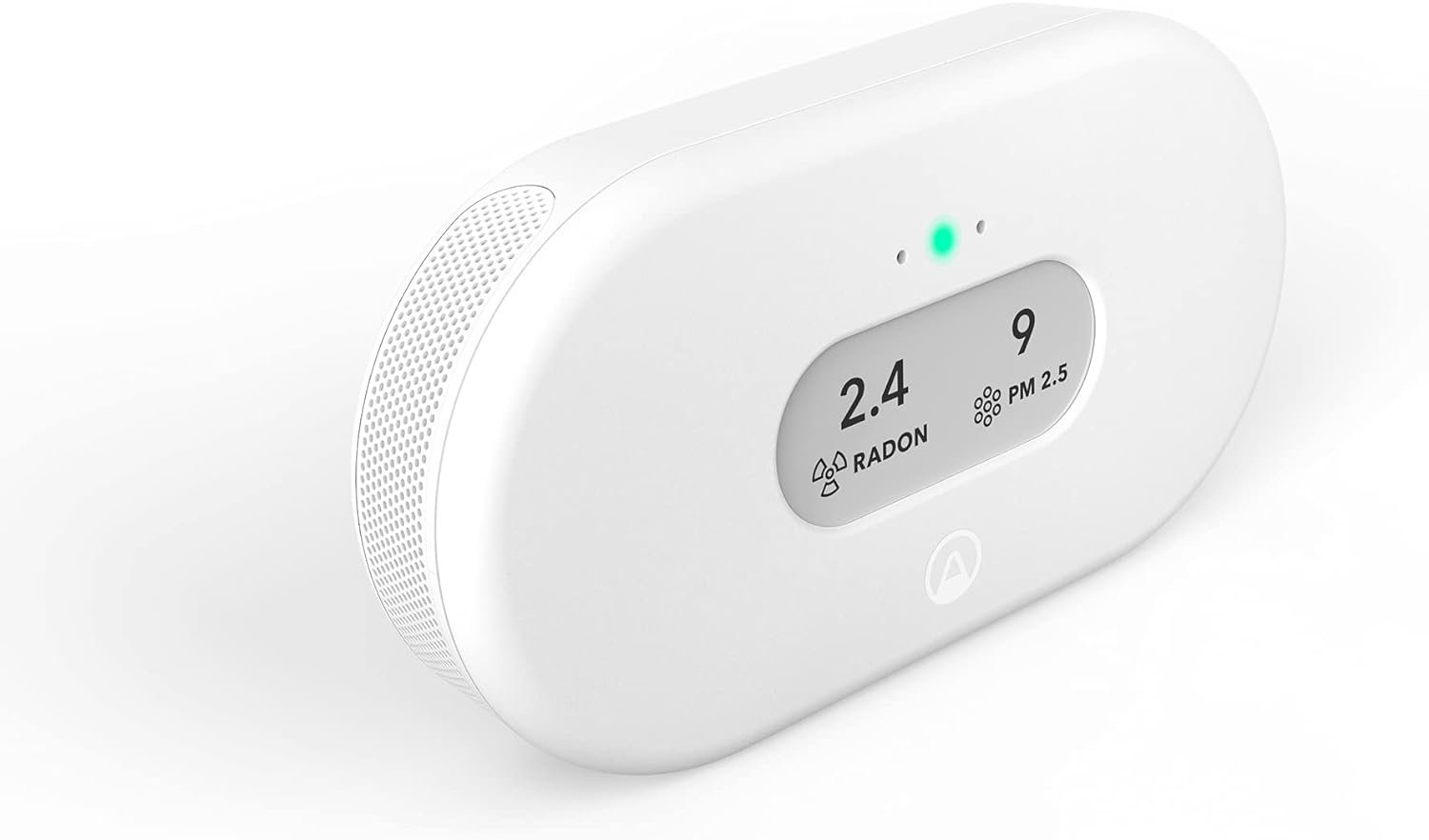

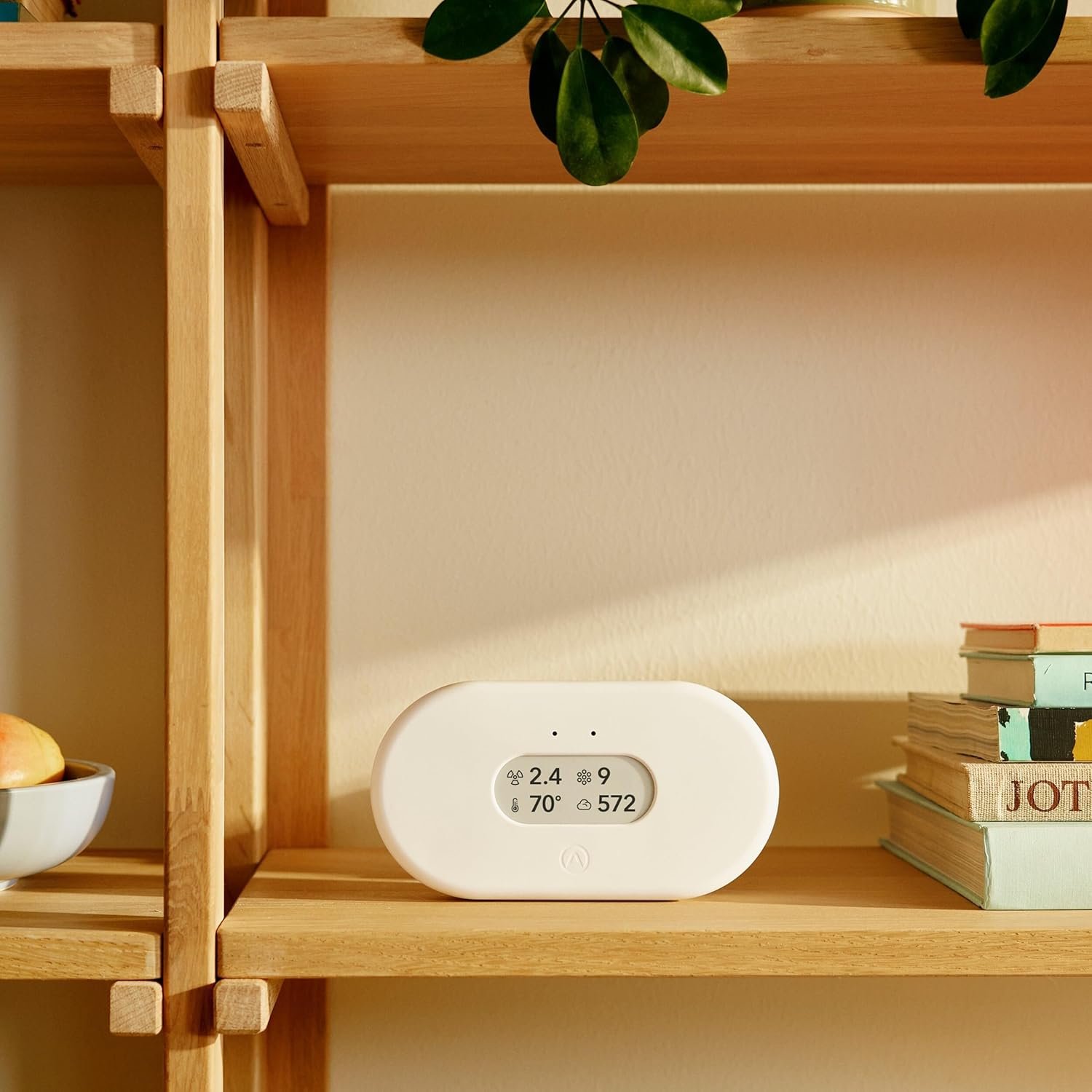





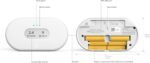
Airthings 2960 View Plus – Battery Powered Radon & Air Quality Monitor (PM, CO2, VOC, Humidity, Temp, Pressure)
Original price was: $329.99.$239.32Current price is: $239.32.
Price: $329.99 - $239.32
(as of Jun 27, 2025 22:59:15 UTC – Details)
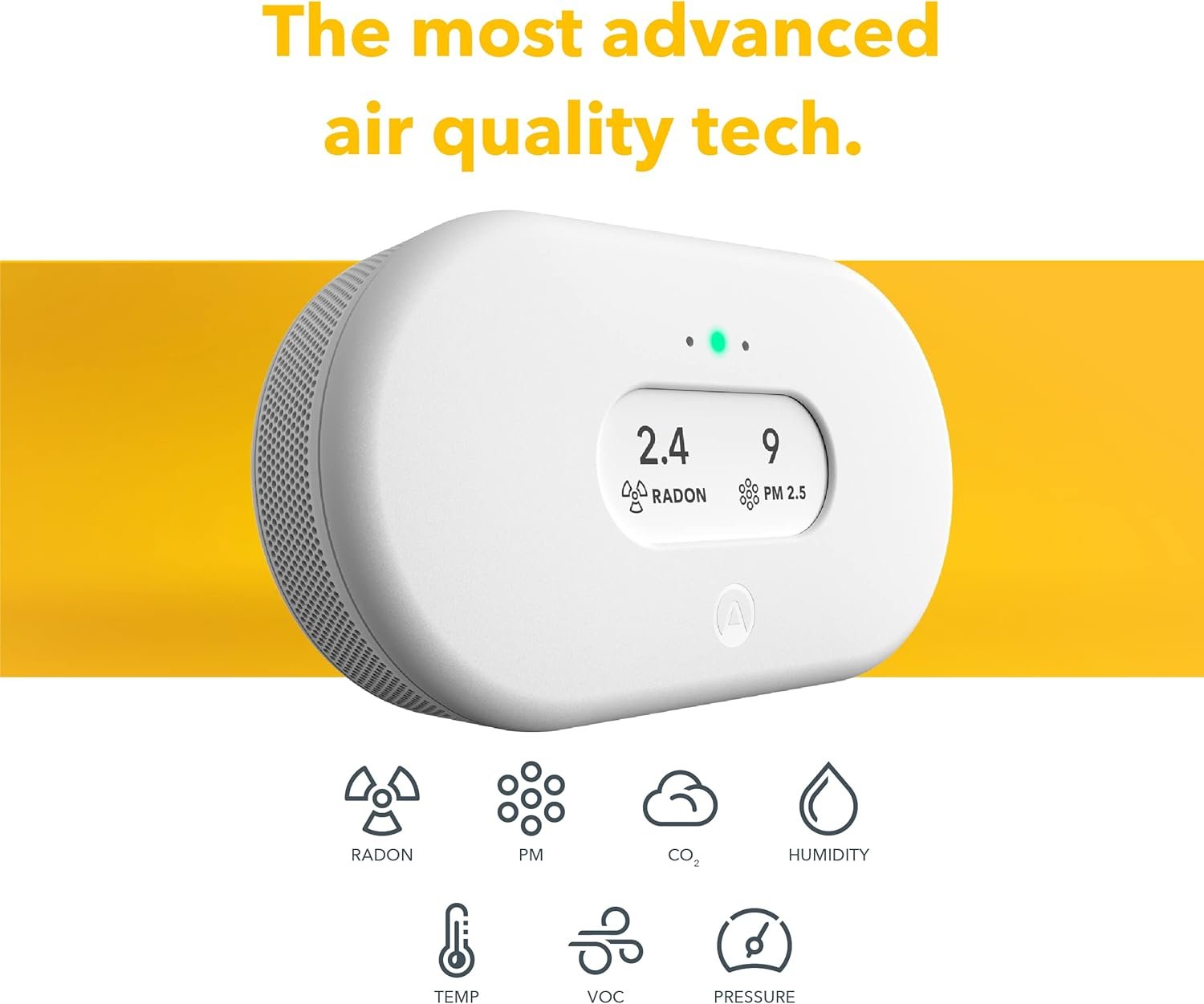
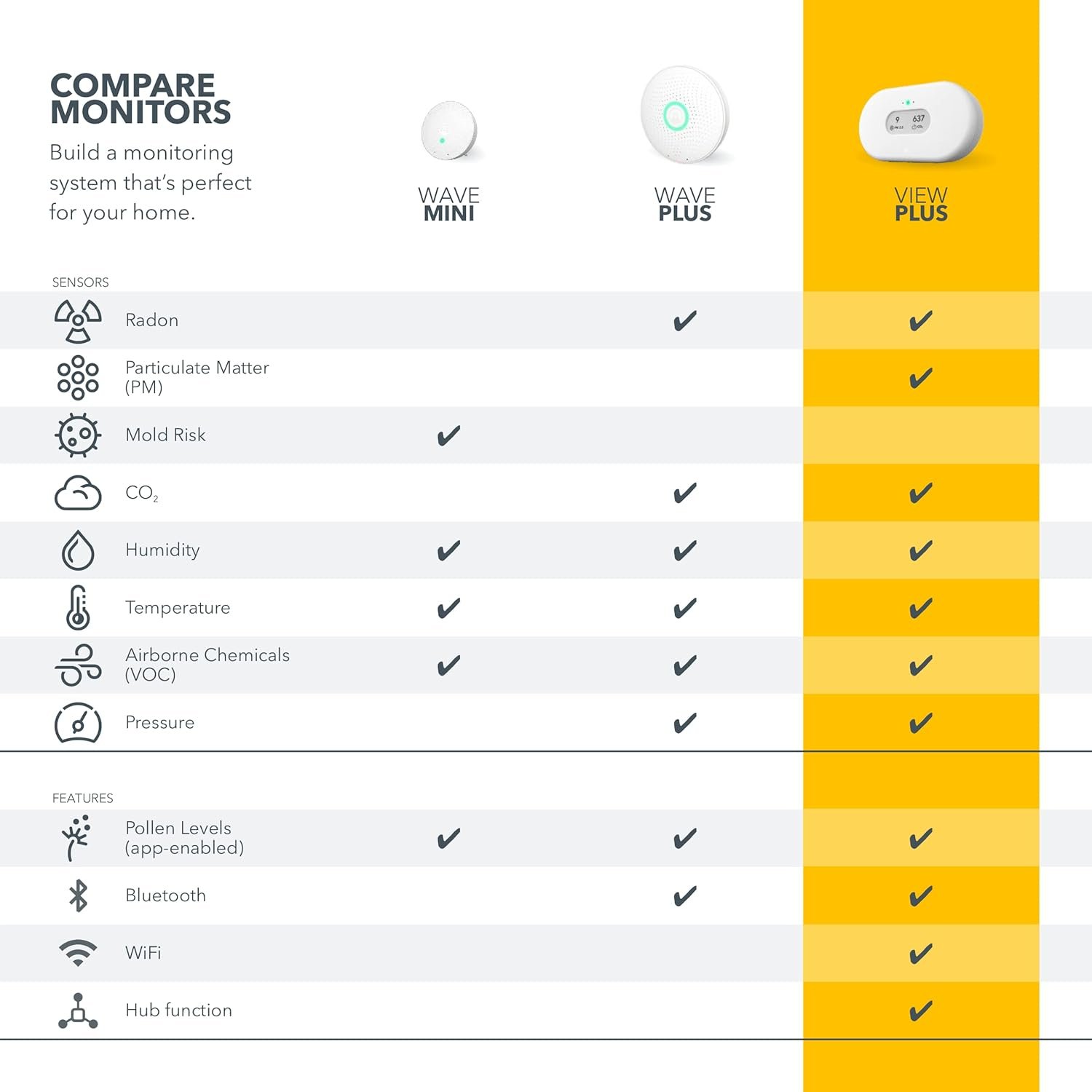
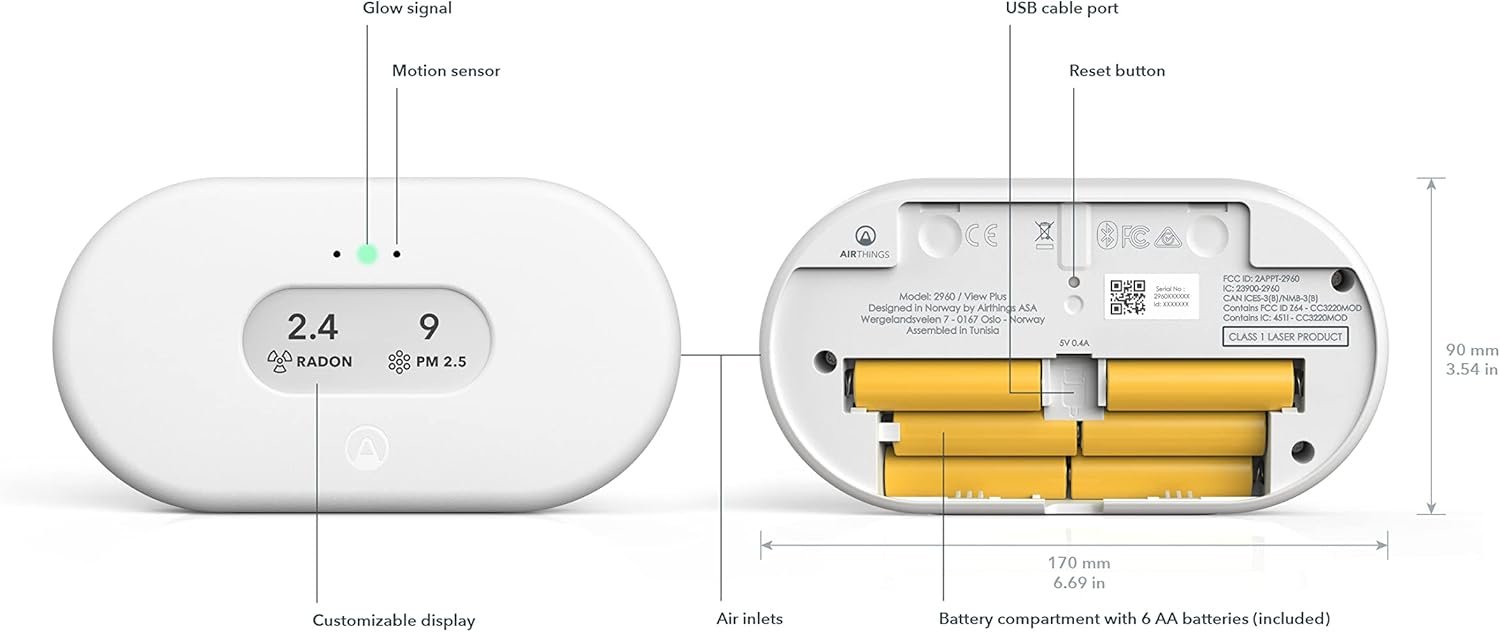
Get the big picture of what’s in the air you breathe at home. Comprehensive, WiFi-connected, battery-operated indoor air quality monitor with always-on radon detection. Get powerful peace of mind with seven air quality sensors. Learn if your home has a radon gas problem that needs fixing. Radon is the number one cause of lung cancer among non-smokers and kills more than 6x the number of people than home fires and carbon monoxide poisoning combined. The digital radon detector uses passive diffusion chamber sampling with alpha spectrometry detection for accurate and reliable readings. Ensure that your radon mitigation solution is working as expected. Always on monitoring lets you identify if your mitigation solution stops working correctly so you can respond quickly. Track the concentrations of fine particulate matter (PM 2.5) in your home’s air. More and more people live in areas affected by city pollution and wildfires, a PM 2.5 air quality monitor can help you understand whether you are affected and how best to minimize the risks of air pollution. Discover the sources of airborne chemicals (VOCs) in your home. Not all VOCs are unsafe but many can cause skin and respiratory irritation. When you link high VOC levels with your symptoms, you are better able to eliminate those VOC triggers. Track CO2 concentrations to optimize airflow in your rooms. Adequate ventilation is key to creating a comfortable environment and decreasing virus transmission risk. Watch in real-time how VOC and CO2 levels go down when you improve ventilation. View Plus connects directly with other Airthings air quality monitors in your home to enable a multi-room monitoring solution.
ALWAYS-ON AIR QUALITY SENSORS: WiFi connected indoor air quality monitor measuring radon gas, PM2.5 (air pollution detector), carbon dioxide (CO2), VOCs (airborne such as kitchen gases, fumes and cleaning products), humidity, temperature, and air pressure. The monitor requires the Airthings app to function. Operating Temperature 4 to 40°C / 39 to 104°F.Sensor type: Electrochemical
ACCURATE DIGITAL RADON DETECTOR: Radon is the number one cause of lung cancer among non-smokers and kills more than 6x the number of people than home fires and carbon monoxide poisoning combined.
SMART AIR QUALITY MONITORS YOU CAN TRUST: With 15 years of experience in indoor radon and air quality monitoring, Airthings has established trust among over 1,000,000 users who rely on its smart monitors for understanding and controlling their air health. An account is required to use the device, which only requires providing your email and name.
CONTINOUS MONITORING: Check your live data anytime and receive timely air quality notifications wherever you are. Track pollutants and contaminants before they become a problem with this always-on indoor radon gas, VOC, CO2, PM2.5 air quality monitor. The monitor and app both require internet access, with data saved securely in the cloud for seamless tracking and analysis.
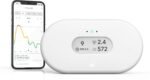
FREE & FRIENDLY APP: Use the Airthings app to check current air quality readings and analyze trends over time. Get timely notifications and tips to improve your air. Check your local pollen forecast with data from Breezometer.
FIVE YEAR WARRANTY: Register for the optional and free extended warranty to increase your standard product warranty to five years.
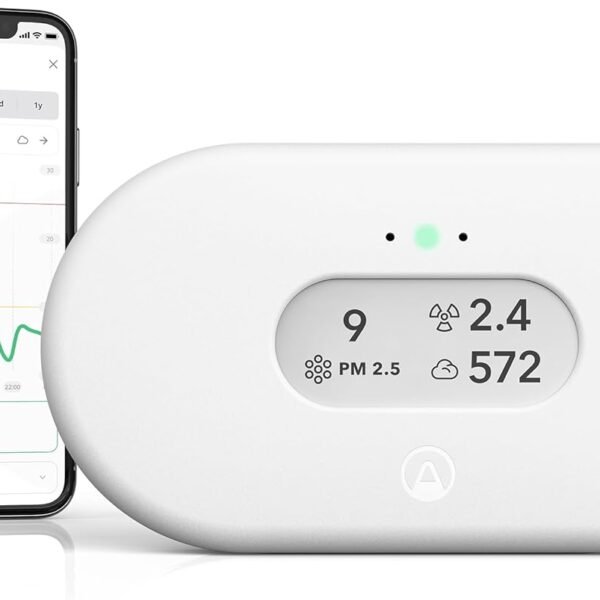
EASY-TO-USE & CABLE-FREE : Quick and easy setup. Understated unit that is battery-powered for cable-free placement. Customizable eInk screen.
Customers say
Customers find the air quality monitor useful for monitoring home air quality and appreciate its radon measurement capabilities. However, the functionality and ease of use receive mixed feedback – while some say it works well and is easy to set up with the app, others report significant setup challenges and zero tech support. Moreover, accuracy and value for money are also mixed aspects, with some finding it accurate and worth the money while others report inaccurate readings and consider it expensive. Additionally, the app quality and connectivity are problematic, with customers reporting that the app is broken and the Bluetooth connection is very unreliable.
9 reviews for Airthings 2960 View Plus – Battery Powered Radon & Air Quality Monitor (PM, CO2, VOC, Humidity, Temp, Pressure)
Related products

3PCS Outdoor Solar Wall Light LED Motion Sensor Bright Flood Street Lamp 3 Modes
In stock


Hisense 100-Inch Class U8 Series Mini-LED ULED 4K UHD Google Smart TV (100U8K) – QLED, 480 Motion Rate, 144Hz Game Mode Pro, Dolby Vision IQ, HDMI 2.1, Alexa Compatibility, 2.1.2 Multi-Channel Audio
In stock

I16 PROMAX Unlocked Phone,8+256GB Smartphone, Android 13.0, Long Battery Life 7000mAh,6.99″ Display 68+108MP Zoom Camera,with Dual SIM, Fingerprint Lock, Face ID, 5G Phone (White)
In stock
Kasa Smart Plug HS103P4, Smart Home Wi-Fi Outlet Works with Alexa, Echo, Google Home & IFTTT, No Hub Required, Remote Control, 15 Amp, UL Certified, 4-Pack, White
In stock

Rossetta Star Projector, Galaxy Projector for Bedroom, LED Night Light Aurora Projector with Bluetooth Speaker, White Noise, Timer and Remote, Room Decor, Gifts for Kids, Adults, Christmas, Birthday
In stock



Amazon Customer –
Multiple sensors with good user interface
Tl:drI recommend this product. I believe that it is currently the best on the market and provides a good array of sensors for the price. I have not received any financial or other consideration for this review. I have no connection to the company. Details, positive and negative, are found in the review.Intro: In operation (after 7-day calibration) for three weeks beginning October 2021. Unit is located indoors in the bedroom of a small single-story home in northern California. I purchased View Plus after an online evaluation of competitive units. The purchase decision was based on the array of sensors, acceptable display of sensor parameters, appearance of a good user interface, ability to easily download the data in Excel .csv file format, designed in Norway, and assembled in Tunisia (visible in product photos). I expect that this is the first product that I’ve ever owned that was assembled in Tunisia. There were no Amazon reviews as I purchased the unit as soon as it became available.My primary motivation for purchase was to measure indoor particulate pollution during the wildfires. I wanted a more quantitative measure than the colored indicators on our air purifiers. However, I have since become more interested in the carbon dioxide (CO2) and VOC levels. The inclusion of Radon, temperature, humidity, and atmospheric pressure sensors is a plus.Particulates: I have had an extended conversation with Airthings via the app. They are responsive, although it may take a few days or even a week, if you ask technical questions as these need to go to the engineering team. As this is a consumer and not scientific device, there are cost limits on the nature of the particle sensor. Airthings does calibrate the particulate sensor to a scientific instrument. However, the Airthings sensor is most likely not able to distinguish between different particle size and scattering distributions that give the same overall signal. I had plans to do a cross correlation study with a scientific instrument, but circumstances conspired against me.At this time, I am satisfied that Airthings has done enough work that the threshold limits (green <10, yellow <25, and red >25 µg/m3) for the PM 2.5 sensor are reasonably close to the equivalent limits used by the US EPA and European PM 2.5 AQI. For the data that I’ve collected, there is very little difference between PM 2.5 and PM 1 signals. I have not investigated why. One caveat is that the data collected so far has an average PM 2.5 and PM 1 values of only 2 µg/m3 and only a single peak greater than 25. Since the rains have (finally) come, I don’t expect to have the opportunity to check against more polluted air conditions in the near term.Carbon dioxide: This provided the most surprise about the conditions in our home. I found that ventilation in our bedroom is insufficient to keep levels in the green without the window(s) being open at night. I am looking into ways to ameliorate this problem when keeping the windows open is not an option. When I first received the unit, I placed it outdoors to see if it would read the expected value of about 400+ ppm for average CO2. The unit read about 550, but it was before the 7-day calibration was completed. Over the course of the past month, when the room was well ventilated, I observed readings as low as 469 ppm. The unit will show the increase in CO2 when either 1 or 2 people are in the unventilated room for any significant period of time.VOC (volatile organic compounds): The measurement is in parts per billion, ppb. This is my first experience with VOC data recording. The unit is certainly responsive and exhibits significant signal when we are cooking, especially frying. As there are many different types of VOC, I cannot comment on whether one should take significant actions based on the results in the home. Do fry-cooks have career related health issues? At a work environment, such as an organic chemistry lab, there may be many types of VOCs that are clearly harmful to health.Radon: All the values that I have recorded are below the green threshold limit of 2.7 pCi/L (picocuries per liter). The average value over 2000 measurements is 0.7 and has a standard deviation of ±0.4.Temperature: Comparing the value to household sensors indicates that the temperature displayed by the Airthings sensor maybe between 1- or 2-degrees F high. However, I consider that within measurement error for accuracy given the nature of the other sensors. Precision appears to be excellent.Relative Humidity: Comparison only with household sensors. Appears to be within a few percent.Atmospheric Pressure: Excellent agreement (within 0.5 mBar) with external values (local weather data). Range of data recorded between 1001 mBar and 1022.5 mBar.User Interface (Unit): There is an E-Ink type display that is not illuminated. This is a very low power display and conserves battery. No power used to maintain the current display reading. It has high contrast and easy readability. You can choose 2 sensors to display via the app (Phone or PC). When you wave your hand in front of the unit, it indicates its assessment of the overall air quality (good, fair, or poor) and shows any of the readings that cause a fair or poor result. It then returns to the standard readout. I have not found the lack of illumination to be detrimental.User Interface (Phone): I’m using a Samsung Galaxy A51 with Android 11. The software allows you to choose among several devices that you might have. As I have only one, it displays a summary that is in the attached photo. You can then tap “VIEW IN WEB DASHBOARD” to get graphic displays for different periods of time. You can choose to get notifications via the app, if values exceed the Airthings recommended thresholds. You can choose the sensors for which to have notifications sent. These thresholds cannot be changed. I think it would be good to be able to change the thresholds with the understanding that one is responsible for the values used.User Interface (PC/Web): I’m using an Intel-based PC running Windows 10 Pro and MS Edge for this unit. See attached photo. The graphing is generally quite good. I’d prefer to be able to choose the order in which the different sensors are displayed. It might be possible to do this by deleting sensor graphs (called tiles) and then adding them back. I’ve not tried that. The vertical scaling is automated and determined by the range of values of the data being displayed. The scale cannot be changed, but you can zoom using touch, if your computer/phone has that capability. Adding the historical data (not shown in the photo) will expand the vertical size of each graph and give the minimum and maximum value for the data range.Bug: You can add a tile for the outdoor weather, but only for Oslo, Norway! They have given me instructions for changing the location, but the software for the View Plus is not the same as for the software shown in the instructions. I have made them aware of this. It is unclear to me whether they can and will offer software updates.Downloading Data: The .csv file contains the time and sensor data for the entire time the system has been recording for that location. If I don’t do something to re-start history, the data file will eventually grow to unmanageable size. They should allow you to specify the range or use the range chosen for the graphing display. The file name is also fixed as the serial number of the unit. These are serious limitations given the extra work caused for the user, I consider them bugs.The data are separated by semi-colons, so converting from text to columns in MS Excel is easy.The data are recorded with a UTC time stamp. Since I’m in California, it is easy enough to subtract 7 hours and put the local time in the next column.The headers have a few character-conversion bugs: “μ” instead of “µ.” The character “” is inserted in the Temperature column header. These are minor.The date/time format is 2021-09-30T20:04:28. The “T” separator is a nuisance and prevents Excel from recognizing the form of the data. If they would replace the “T” with a space, then Excel would have no trouble. I use the replace function to do this. Again, it is no big deal, but should be a simple fix. I have made Airthings aware of these bugs.I will append this review, if I find additional information that may be pertinent to other users. I hope this has been helpful.Appendix 1: I’ve added a comparison of the PM2.5 data from the Airthings View Plus (indoors near an open window) to Purple Air data from an outdoor sensor (not mine) about 100 meters from my home. The Purple Air data are shown in the US and European scales. The data are for the 24 hours of October 29, 2021. Correlation is excellent for the main peak.
A. Cordeiro –
Expensive, but gives you the info you want.
I upgraded from a little sensor that just detected particulates to this bad boy that picks up VOCs and CO2 levels, and this shed some light on things. I live in a rural area where neighboring farmers fertilize their fields, and stuff goes in and out of season, with VOC levels to match. I also was sealing up my bedroom in the winter, and my air handler had quit, and this unit gave me a heads-up that my CO2 levels were getting unhealthy. The e-ink display is clear, and the “wave hand in front of unit for green-yellow-red” is a great feature – I may end up getting one or more of these for my paranoid mom who’s worried about her tiny dog getting exposed to radon. The dog is going to inherit the estate, after all – won’t someone think about the dog?Also, easy setup, none of this “go join this rando wifi network, set a thing, go back to normal network, pray to the wifi gods…” nonsense. Just pull the plastic tab for the batteries, launch the app, and go. Well-designed.
Alex –
Good until it broke three months later
Initially my View Plus worked great – pairing and setup was simple and the device reported data without any issues. The results looked accurate when compared to other air quality and temperature/humidity sensors that I have in my home. I like the UI in the app and the alerting features. The fact that only two metrics can be displayed on the View Plus device itself is a little annoying, but generally not a problem if you are mostly using the app.All was good until I needed to reconnect the device to my wifi network. At this point, the device was unable to ever find any wifi networks again. This is clearly a device problem since my phone displays 10+ networks available to connect to. After trying the various troubleshooting guides on Airthings support site, trying factory resets, trying to connect with a different phone, using an older app, etc.. the View Plus device is still stuck in a state where it can’t detect any wifi networks and hence can’t finish the setup process. This renders it completely useless and it is not just sitting there as an expensive paperweight.After trying everything, I contacted the customer support via the app. Airthings support is completely abysmal. You will be lucky to get a generic response from them within a week. At this point, I’ve been in a conversation with them where I am lucky to get a response. If it does come – a week later typically after I follow up – the response always begins with “Sorry for the late response” followed by basic troubleshooting instructions that I have mentioned already trying. I have asked for a refund or a replacement device as mine is still covered by their one-year warranty, but this request has completely been ignored by their support team.Bottom line is the device works great initially, but if there is ever a failure with it you are almost guaranteed to be out $300+ while trying to contact an almost non-existent support staff.
Lloyd Mcgarrigal –
Insightful Air Quality Monitor with User-Friendly Features
I recently upgraded to this advanced air quality monitor from a basic sensor, and the difference is remarkable. Living in a rural area with fluctuating VOC levels due to neighboring farming activities, this device has been a real eye-opener. It alerted me to unhealthy CO2 levels when sealing my bedroom for winter and my air handler malfunctioned. The e-ink display is crystal clear, and the color-coded indicator for air quality is a fantastic touch. The straightforward setup process, without the hassle of complex wifi configurations, was a breath of fresh air. I’m considering getting more units for my safety-conscious mother, who frets over her pet dog’s exposure to radon. The thought of her dog inheriting the estate drives her concern! Overall, this monitor is user-friendly and well-designed, making it a perfect addition to any home.
Carlo –
Rilevatore di inquinamento assolutamente eccezionale, la cui unica pecca è il prezzo un po’ alto.PRO:- Facilità d’installazione: si installa in pochissimi minuti, le istruzioni sull’app sono molto chiare e comprensibili.- Radon: uno dei pochissimi in grado di rilevare anche il radon, solitamente si deve comprare un dispositivo dedicato.- Personalizzazione: il dispositivo può mostrare 2 tra le tante informazioni che rileva (PM, CO2, Radon, Umidità, ecc…)- Può funzionare sia a batteria, che via cavo USB C, che con entrambe le fonti di alimentazione.- Ha un piccolo sensore sulla parte frontale che consente di avere un riepilogo degli inquinanti quando si passa la mano davanti.- Disponibile sia da APP che via browser, un riepilogo completo con tanto di grafici, dati medi, dati aggregati, ecc…- Il tutto ha già delle scale di valori per cui quando i valori diventano gialli o rossi si ha intuitivamente un idea sulla gravità degli inquinanti rilevati.- Possibilità di avere delle notifiche da App quando si superano le soglie su uno o più inquinanti.- Anche se manca la connessione a internet il dispositivo conserva le informazioni per qualche ora e se torna disponibile le carica con le altre.- Viene fornito già con un cavo USB –> USB C di una lunghezza molto alta, molto utile.CONTRO:- Non è disponibile la lingua italiana.- Prezzo un po’ alto, preso in sconto a poco più di 200€, a 300€ non so se l’avrei preso.- Fa un piccolo rumore quando si aggiorna per rilevare gli inquinanti, può dare fastidio se lo si tiene vicino a dove si dorme, nel caso basta alimentarlo via cavo e staccarlo di notte.- Il display non è retroilluminato, quindi serve sempre avere una fonte di luce per leggerlo.Consigliatissimo.
LunchBoxSteve –
I bought this to monitor the air in my 10x10ft room because I’m in it all day due to being disabled and in bed most of the day due to chronic pain. I’m on a lot of medication that makes me tired and so having good quality air in the room to help me from feeling tired is a necessity. I also need to monitor the air for particulate like PM 2.5 because of my asthma. I’m happy to report that this air quality monitor does all that along with VOC’s, temperature, humidity, radon levels and for the possibility of mold. I was alarmed to realize that the CO2 levels were higher than outdoor air at 1637ppm (Should be 400ppm or lower). I have since opened the window in my room to air out the room and now I keep the window open a little bit to keep a constant fresh air supply into my room. I feel so much better already with how drowsy I am and the only change I made was making sure I get more fresh air. Homes today are so tightly sealed unlike older homes so they don’t “breathe” and allow in enough fresh air on their own so these VOC’s, pollutants, and CO2 can really build-up and make you not only feel tired but also be bad for your health. It really made a difference for me. I like that it can provide alerts to my smart phone via a WiFi connection so I know to open a window without having to look over at the air-monitor. I would suggest everyone get one. It will make a difference in your life and when it’s on sale like it is now with Prime Day’s it’s a great price! Even cheaper than AirThings own website.
Kieran –
I ordered this Airthings View Plus air quality monitor as it seemed to be well regarded and more professional than the other ones available and it could also read radon gas levels, something which is rare in such a feature rich device like this one. It is one of the reasons it costs so much. What surprised me is just how fast CO2 levels build in a small-medium sized bedroom within a short space of time if the windows and doors are closed. I wasn’t expecting that. I am talking about just a few minutes. The other one was the VOC (volatile organic compounds) reading. Mine was reading between 40 and 80 on average, within acceptable levels. However when I opened a moisturiser bottle to put moisturiser on my face and head as I suffer dry skin, the VOD reading jumped to nearly 4,000 in just a minute or so. It’s amazing what is in the air we breath, and it is more often bad than good. I now use a air purifier in my bedroom and make sure my windows are always open slightly, even if it is cold outside. I am happy with my purchase, and I think the app is useful. There was an additional app I was offered to download that is just called Airthings, rather than Airthings Wave, and it is a little confusing why they have two apps that do the same thing, but it seems the one just titled Airthings is the one that’s been updated most recently. I prefer the older Airwaves Wave app though as the layout is better and it gives you CO2 readings and radon gas levels earlier on after initial setup than the app just titled Airthings.
Rodrigo –
I am still waiting for some values because it takes time for some parameters.But overall it feels like an accurate device.
Brandon –
I am a fan of Airthings products. I ordered two and I am very satisfied with it so far. Here are my feedbacks. I hope you guys can keep it up and do better.Strength:1. The light and noise sensors are more useful than I originally thought. For instance, the light sensor helped me make decision if I need to add black out curtains to the room. I doubt the accuracy of VOC sensor. Given that identifying harmful VOC is really hard and complicated, it is reasonable to me. It is good to have it and it does capture the change.2. The CO2 sensor is accurate and reminds me to open windows and exchange the air regularly even tho we have HRV running 24/7 at maximum capacity. I was surprised by the CO2 level especially during the sleep with door closed.3. Nice look, good app, visualized graph, long-term data and easy setup just like other Airthings products.4. One specific thing I really like the enhance is that it has really clear purpose and scenario, which is mainly used in bedroom/office. The combination of sensor makes lots of sense to me as I don’t like putting multiple sensors on the wall. Although it is missing the pm2.5, its price is more affordable and can be covered by the purifier.Areas of improvement:1. The app can be more optimized for the enhance. For example, the app does not show the remaining battery life which is on the web dashboard.2. It maybe a good idea to add “identifying sensor” to the app. If consumer bought multiple units with the same looks, they can easily mixed up the sensors. It is difficult to tell which is which. For instance, the “find the sensor” may trigger the one to blink signal light. It is the feature I saw on my wifi mesh equipments.3. It works without hub from my understanding. However, to get real time data, it requires a Airthings hub. I have a wave view plus at ground level, therefore, it was not an issue to me.